
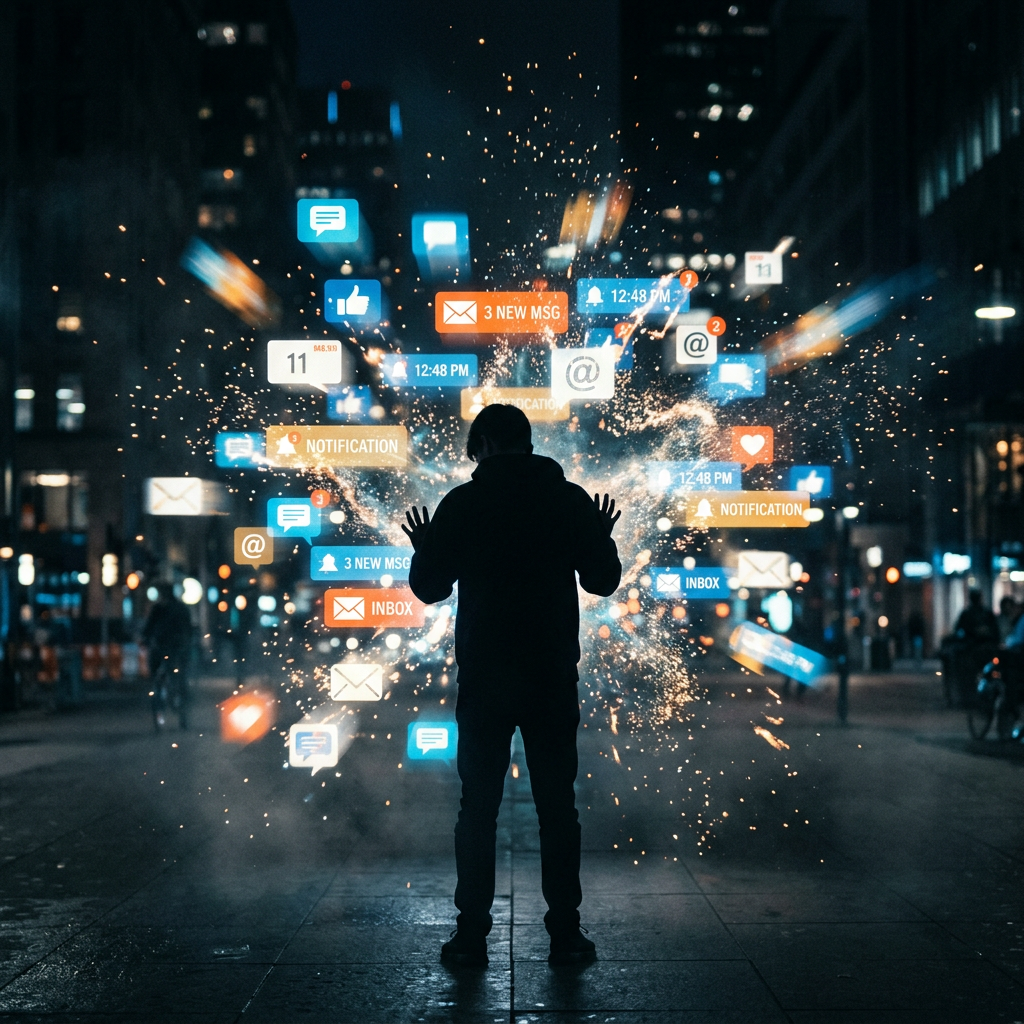
There is a quiet crisis sitting underneath every dashboard in marketing right now. Reach is up. Impressions are up. Ad spend is up. And almost none of it is landing. We have entered what I call the Great Attention Recession: a period where attention has become the scarcest currency in the economy, and where most brands are still spending it like it is free.
The numbers are blunt. Research from Amplified Intelligence found that roughly 85 percent of online ads never cross the 2.5-second threshold at which a brand begins to embed itself in memory. By Optimove’s 2025 reporting and related industry analysis, the majority of consumers now describe themselves as marketing-fatigued. Ad blocking sits near a third of users in major markets. Instagram’s public engagement, by some 2025 measurements, collapsed from around 3 percent to below 1 percent in roughly a year. The pipes are full. The signal is gone.
But before you blame the goldfish, let me correct the myth that has misled marketers for a decade.
Attention spans are not shrinking. Tolerance is.
The famous claim that humans now have an eight-second attention span, shorter than a goldfish, was never real science. It came from loosely sourced surveys, not peer-reviewed neuroscience, and there is no large-scale longitudinal study showing population-level attention is biologically contracting. People still binge seven-hour series, sit through three-hour films, and lose entire evenings to a single video game. Attention is intact.
What has changed is the psychology of supply and demand. We are not running out of attention. We are drowning in things competing for it, and the brain has adapted with a ruthless filter. This is the real engine of the recession, and it has three layers worth understanding.
Habituation. The brain is built to ignore the predictable. Neurologically, novelty triggers a reward response and repetition deadens it. When every brand uses the same hooks, the same trending audio, the same “POV” framing and the same AI-smoothed stock aesthetic, the nervous system files all of it under “seen this,” often before conscious thought engages. Neuroscience research is consistent on this point: emotional evaluation happens within a few hundred milliseconds, faster than reasoning. Audiences decide whether your content matters before they decide what it is.
Cognitive load and decision fatigue. Consumers are not only tired of ads, they are tired in general. In late-2025 research cited by Ovative, around 42 percent of people described screens as overwhelming, searches for “digital detox” rose roughly 400 percent year over year, and close to 69 percent said they felt unable to plan long term amid economic and political pressure. A depleted brain does not weigh your value proposition. It defaults to the easy “no,” which is to scroll past.
Algorithmic resistance. This is the newest and most strategically important shift. As Mintel documents heading into 2026, consumers have become aware that the feed is engineered to extract their attention, and a growing share are pushing back: setting boundaries, muting, leaving platforms, and treating algorithmic content with active suspicion. Younger audiences are simultaneously the heaviest users and the loudest critics. Add the flood of generative “AI slop,” which advertising analysts now name explicitly as a 2026 fatigue driver, and you have an audience that has learned to distrust polish itself.
So the problem is not that people cannot pay attention. It is that they have become extremely good at deciding what is not worth it, and most marketing is failing that test in under three seconds.
How brands break through
Breaking the recession is not about shouting louder or buying more reach. Volume is the disease, not the cure. It is about earning a place past the filter. Six moves matter most in 2026.
1. Optimize for the first two seconds, then for memory
If 85% of ads die before 2.5 seconds, the opening frame is not a warm-up, it is the entire transaction. Dentsu’s attention research found that even a 5 percent lift in attention can drive a 40 percent jump in in-market ad awareness. The leverage is enormous and it is concentrated at the very front. Audit your creative by its first frame and first line in isolation. If a stranger scrolling at speed cannot tell within two seconds why this is worth a third second, the rest of the asset is irrelevant. Then build for memory, not just the view: a distinctive visual, sound, or phrase that survives after the scroll.
2. Treat distinctiveness as a survival trait, not a style choice
Habituation punishes sameness, which means the riskiest thing a brand can do in 2026 is look like its category. The brands breaking through are the ones willing to be specific, strange, opinionated, and unmistakably themselves. This is where craft beats efficiency. AI can generate infinite competent content, which is exactly why competent content no longer registers. Use AI to accelerate the boring parts and protect human originality where it counts: the angle, the voice, the point of view that no model would default to.
3. Earn trust by being legibly human
Algorithmic resistance and AI-slop fatigue have created a strange advantage for anything that reads as authentically human. Unpolished, candid, founder-led, and behind-the-scenes content increasingly outperforms high-gloss production, not because quality stopped mattering, but because visible humanity now signals “real, therefore worth attention.” For personal brands especially, this is the moat. Show the process, the reasoning, the imperfection. The filter that rejects ads tends to let people through.
4. Move from interruption to invitation
Interruptive advertising assumes attention can be taken. In a recession, it has to be invited. That means shifting budget and creativity toward formats people actively choose: useful long-form, communities, newsletters, live moments, and IRL experiences. Note that email remains the channel consumers say they most prefer for brand messages, far ahead of social, precisely because it is permissioned. The lesson generalizes: opted-in attention is worth far more than intercepted attention, and it is far more durable.
5. Anchor to identity and culture, not just the product
Consumers protecting their attention will still spend it generously on things that feel like part of who they are: fandoms, communities, subcultures, shared rituals. The brands winning in 2026 attach themselves to identity and meaning rather than features. This is the difference between an ad someone tolerates and content someone forwards because it says something about them. Belonging beats broadcasting.
6. Stop measuring the wrong thing
If your reporting still optimizes for impressions and clicks, you are optimizing for the recession, rewarding reach that never converts to memory. Attention metrics, qualitative resonance, branded search lift, and saved or shared rates are far better proxies for whether you actually broke through. Measure whether you were remembered, not merely whether you were served.
The reframe for 2026
The Great Attention Recession is not a temporary dip to wait out. It is the new operating environment, and like any recession it separates the brands that adapt their behavior from the ones that keep doing more of what stopped working. The instinct under pressure is to increase volume. The discipline that wins is the opposite: fewer, sharper, more distinctly human things, built to clear the filter rather than feed it.
Attention has not disappeared. It has simply become honest about what it is willing to pay for. The brands that respect that, that treat a person’s attention as something to be earned rather than harvested, will not just survive the recession. They will quietly take market share from everyone still shouting into the noise.
Sources informing this piece include Amplified Intelligence and Dentsu attention research, the 2025 Optimove Consumer Marketing Fatigue Report, Mintel’s 2026 digital-fatigue analysis, Ovative’s 2026 trends report, Advertising Week’s 2026 media trends, and Brillity Digital’s critique of the attention-span myth.

